Solar Battery Cost 2026: What You'll Actually Pay Per kWh (By Brand & Country)
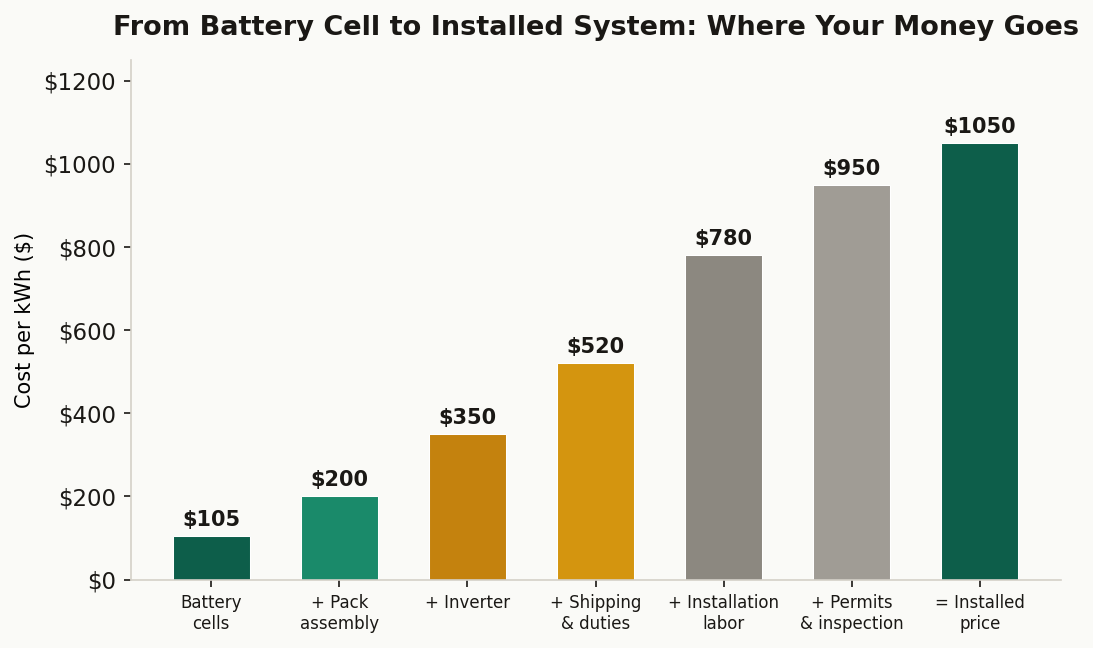
A home solar battery costs between $6,000 and $16,500 installed in 2026 for a typical 5–13.5 kWh system. That works out to roughly $850–$1,700 per usable kilowatt-hour of storage. But the raw battery cells themselves? Only about $105/kWh at the pack level (via BloombergNEF's 2026 forecast). The gap between cell price and your installed bill — roughly 8–16× — is labor, inverter hardware, permitting, distributor margins, and installer markup. Understanding that gap tells you where your money goes and how to save.
The total cost depends on three things: which battery you buy, which country you live in, and whether you qualify for local incentives. Use our solar battery calculator to model your system size first, then use the price data below to budget realistically.
How much does a solar battery cost in 2026?
The short answer: about $6,000–$16,500 installed for a residential system. But that number hides enormous variation. A compact 5 kWh Enphase battery costs very different money than a 13.5 kWh Tesla Powerwall 3. And the same Powerwall costs different amounts in California vs South Africa vs Nigeria.
Here's the installed price range by capacity tier, based on actual installer quotes aggregated across the 22 countries our calculator serves:
| System Size | Battery Cost (EXW) | Installed Price Range | Typical Use Case |
|---|---|---|---|
| 3–5 kWh | $900–$2,500 | $2,500–$6,000 | Apartment backup, essentials (lights, fridge, WiFi) |
| 5–10 kWh | $1,500–$5,000 | $5,000–$11,000 | Family home backup, self-consumption from solar |
| 10–15 kWh | $3,000–$7,500 | $9,000–$18,000 | Whole-home backup (excl. AC), load shifting |
| 15–20+ kWh | $4,500–$10,000 | $13,000–$25,000+ | Full off-grid, large homes with AC, commercial |
EXW = ex-works price (factory gate, before shipping, duties, and installation). Installed price includes inverter, labor, permits, and basic electrical work. Source: SolBatteryCalc internal pricing data, distributor quotes Q2 2026.
We've helped homeowners in 22 countries size their systems over the past year. The single biggest mistake we see: people budget for the battery but forget the inverter and installation, which together often equal the battery's EXW price.
Why do battery cells cost $105/kWh but I'm paying $1,000+/kWh installed?
This is the question we get most often from customers who've read BNEF's headline numbers. The answer explains the entire economics of home storage.
Battery cells ($105/kWh) are what come out of the factory — raw lithium iron phosphate (LFP) cells, unpackaged, without a battery management system (BMS), enclosure, thermal management, or certifications. Think of it like buying a car engine and asking why a complete car costs 10× more.
What happens between the cell and your wall:
Pack assembly (+50–100%) — cells are welded into modules, a BMS is integrated, a metal enclosure with IP65 rating is built, and the unit is tested and certified (UL 9540 in the US, IEC 62619 internationally). A 5 kWh pack now costs $1,500–$2,500 at the factory gate.
Inverter (+$1,500–$4,000) — the battery stores DC power; your house runs on AC. A hybrid inverter bridges that gap. Some batteries (Powerwall 3) include the inverter; others (LG RESU, BYD) require a separate unit. This is the single biggest line item most buyers overlook.
Shipping, duties, distribution (+20–40%) — a battery shipped from China to Lagos or Lima pays freight, insurance, import duties (10–30% depending on country), and at least one distributor margin. By the time it reaches a local installer, the landed cost is 1.5–2× the EXW price.
Installation labor (+$1,000–$3,500) — a licensed electrician spends 1–3 days mounting the battery, wiring it to the inverter and main panel, configuring the system, and testing. Labor rates range from $30/hour (Johannesburg) to $150/hour (San Francisco).
Permits and inspection (+$200–$2,000) — varies wildly by jurisdiction. A simple installation in rural Kenya may need no permit. A battery in San Jose, California requires electrical permit, building permit, utility interconnection application, and sometimes a fire code inspection (battery placement restrictions).
Your $105/kWh cell becomes a $1,000+/kWh installed system because you're not buying a battery cell — you're buying a UL-certified, fire-safe, warranty-backed energy appliance installed by a professional and approved by your utility.
Brand-by-brand installed price comparison (2026)
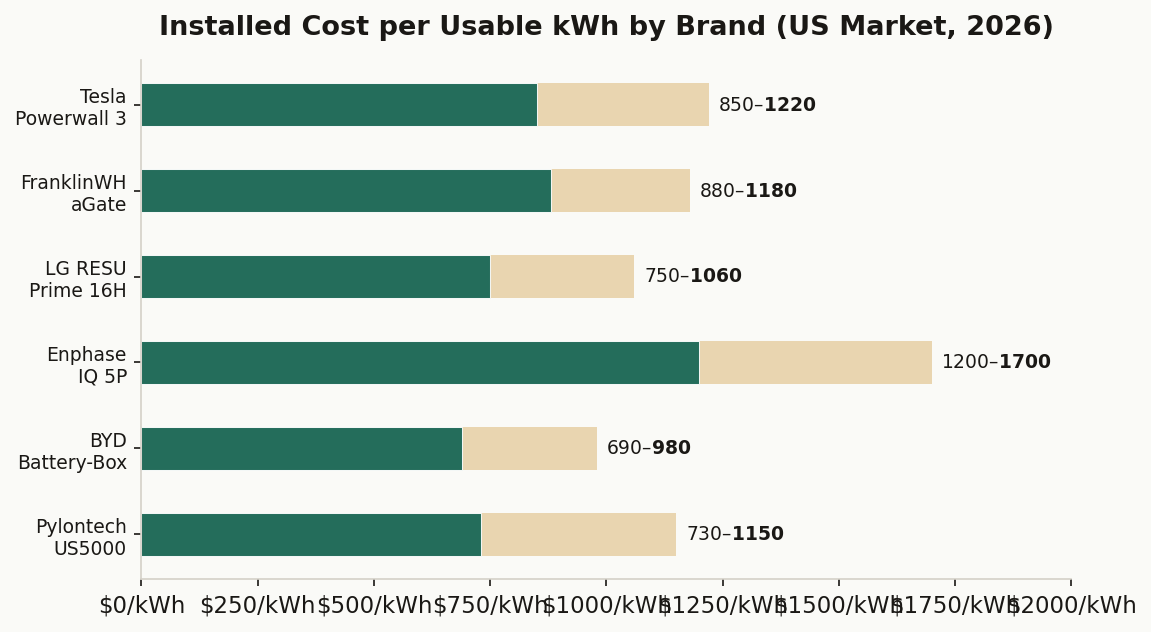
Prices below reflect typical US installed costs in mid-2026. Subtract 20–35% for markets with lower labor costs (South Africa, Southeast Asia) or fewer permitting requirements. Add 15–30% for remote installations or premium labor markets.
| Brand / Model | Usable Capacity | Installed Price (US) | $/kWh Installed | Key Feature |
|---|---|---|---|---|
| Tesla Powerwall 3 | 13.5 kWh | $11,500–$16,500 | $850–$1,220 | Integrated inverter, 97.5% efficiency |
| LG RESU Prime 16H | 16 kWh | $12,000–$17,000* | $750–$1,060 | Largest single-unit capacity |
| Enphase IQ Battery 5P | 5 kWh/unit | $6,000–$8,000 | $1,200–$1,700 | 15-year warranty, modular |
| FranklinWH aGate | 13.6 kWh | $12,000–$16,000 | $880–$1,180 | Whole-home backup focused |
| BYD Battery-Box HVS | 10.2 kWh | $7,000–$10,000 | $690–$980 | Best value, widely available globally |
| Pylontech US5000 | 4.8 kWh/unit | $3,500–$5,500 | $730–$1,150 | Popular in Africa/Asia markets |
*LG RESU requires separate inverter ($1,500–$3,000). Total installed price shown includes inverter.
⚠️ Important 2026 context: The US federal solar ITC (30% tax credit) expired on December 31, 2025. Systems installed in 2026 no longer qualify for the federal credit. Some state-level incentives remain (California SGIP, Massachusetts ConnectedSolutions, New York NY-Sun), but the era of a 30% federal discount on batteries is over for now. Our calculator factors in your specific state or country's current incentives.
How much does a solar battery cost by country?
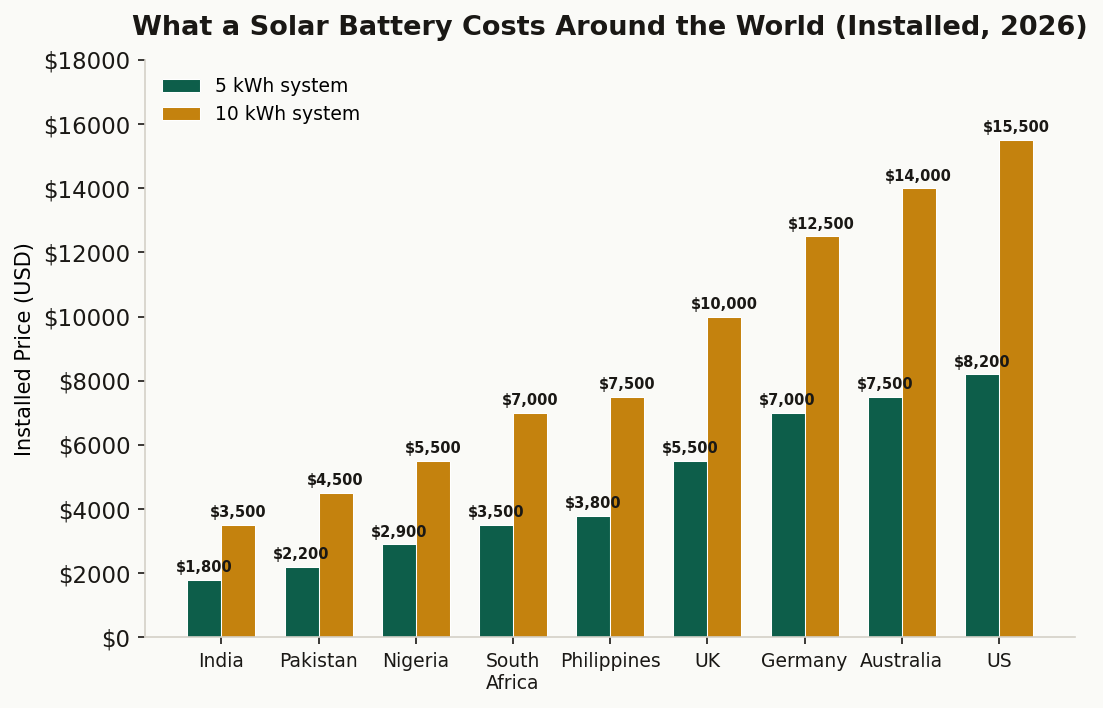
This is where prices diverge dramatically. The same 5 kWh lithium battery that costs $6,000 installed in California might cost $2,200 in Lagos or $3,800 in Johannesburg. Labor rates, import duties, distributor competition, and permitting requirements create massive regional spreads.
| Country | 5 kWh System (Installed) | 10 kWh System (Installed) | Key Cost Driver |
|---|---|---|---|
| United States | $6,000–$9,000 | $11,000–$18,000 | High labor + permitting |
| South Africa | $2,500–$4,500 | $5,000–$9,000 | Competitive installer market |
| Nigeria | $1,800–$4,000 | $4,000–$8,000 | Low labor, high import duties |
| Philippines | $2,500–$5,000 | $5,000–$10,000 | Moderate labor, net metering available |
| United Kingdom | £4,000–£7,000 | £7,000–£13,000 | VAT 0% on battery storage |
| Germany | €5,000–€9,000 | €9,000–€16,000 | High labor, KfW subsidies available |
| Australia | AUD 6,000–11,000 | AUD 11,000–19,000 | Mature market, competitive pricing |
| India | ₹90,000–₹200,000 | ₹180,000–₹400,000 | Cheapest globally, booming market |
| Pakistan | PKR 300,000–600,000 | PKR 600,000–1,200,000 | Low labor, high duties on lithium |
Prices include battery + inverter + installation. All figures are 2026 estimates based on SolBatteryCalc installer network data and local distributor quotes. Check our country-specific guides for detailed local breakdowns.
We've found that our Nigeria and South Africa customers pay 40–60% less for installation than our US customers — not because the equipment is cheaper (imported batteries actually cost more in Nigeria after duties) but because an electrician in Lagos charges $20–40/hour vs $100–150/hour in California.
How do I calculate whether a solar battery is worth it for me?
The math is straightforward, but most online calculators get it wrong because they use generic averages. Here's the formula we use:
Annual savings = (kWh stored per day × days per year × your electricity rate) + (avoided generator fuel cost, if applicable)
Then: Payback period (years) = total installed cost ÷ annual savings
A real example from a customer in Johannesburg, South Africa (Stage 4–6 load shedding):
- System: 5 kWh lithium battery + 3 kW inverter + 2 kW solar panels
- Installed cost: R55,000 (approx. $3,000)
- Daily storage used: 4 kWh (shifted from grid to stored solar)
- Eskom tariff: R3.70/kWh ($0.20)
- Annual savings: 4 kWh × 365 × R3.70 = R5,402/year
- Payback: R55,000 ÷ R5,402 = ~10 years from bill savings alone
But that's only half the story. This same customer avoids running a generator for 4 hours daily during load shedding — saving roughly R15,000/year in petrol. Add that in, and payback drops to 2.8 years. After that, the system generates free power for the remaining 7–10 years of battery life.
This is why we built our calculator to ask for your actual appliances, outage hours, and local electricity rate — not just generic averages. Try it for your home: plug in your real numbers and see the payback.
What's the cheapest solar battery that's actually reliable?
The cheapest lithium battery we'd recommend is a Pylontech US5000 (4.8 kWh) at about $1,000–$1,400 EXW per unit, or a BYD Battery-Box HVS system starting around $3,500 for 5.1 kWh. Both use LiFePO4 chemistry, have proper BMS protection, and come with 5–10 year warranties.
What we would NOT buy:
- No-name lithium batteries from AliExpress/Alibaba without a local distributor — counterfeits and degraded cells are common. One Nigerian customer sent us photos of a "5 kWh" battery that opened to reveal repurposed e-bike cells with a sticker over the original label.
- Deep-cycle lead-acid batteries for daily cycling — they're half the upfront price but last 2–3 years vs 10+ for lithium. Over a decade, lithium costs 50–60% less per usable kWh cycled (see our battery vs generator comparison for the full math).
- Any battery without a local importer who honors warranty — if you have to ship a 50 kg battery internationally for a warranty claim, you have no warranty.
For most homes in Africa and Southeast Asia, the value sweet spot is a Pylontech or BYD lithium battery with a separate hybrid inverter (Victron, Deye, or Sunsynk). These brands have established distributor networks across 20+ countries and local warranty support — more important than saving $200 on a cheaper brand.
Are solar battery prices going down? Should I wait?
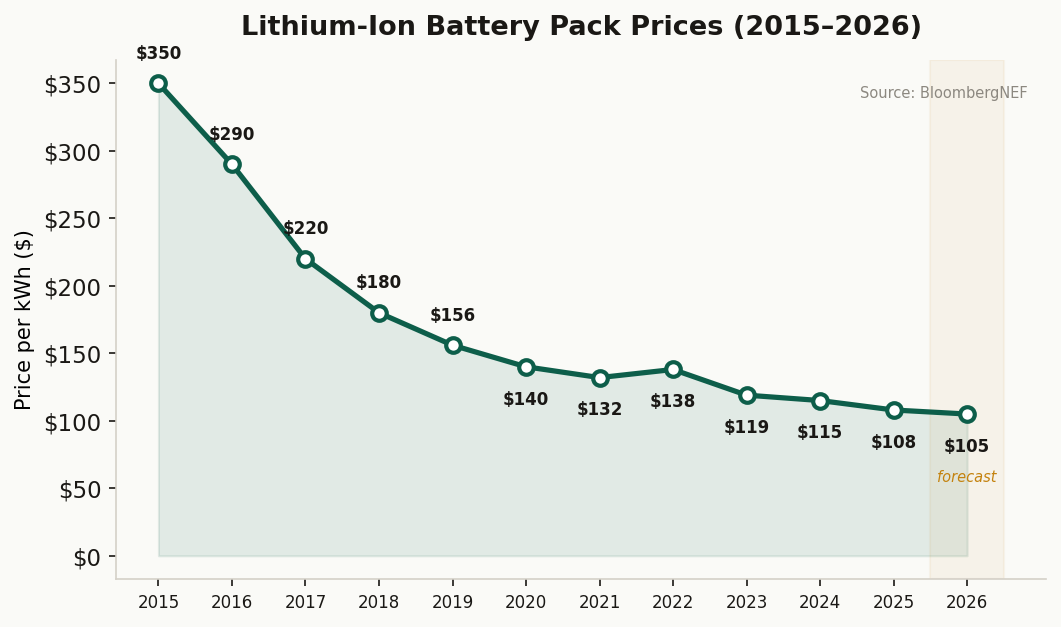
Yes, prices are falling — but slowly. Battery pack prices dropped from $115/kWh in 2024 to $108/kWh in 2025, and BNEF forecasts $105/kWh in 2026. That's a 3–8% annual decline, not the 20%+ drops we saw in 2015–2020.
The case for buying now:
- A 5% price drop next year saves you about $250–$500 on a complete system. If you're paying $150/month in generator fuel (common in Nigeria, Pakistan, and South Africa), waiting one year costs you $1,800 in fuel — far more than the price drop saves.
- Import tariffs are trending up, not down. The US just raised tariffs on Chinese lithium batteries to 25%. Several African countries are considering similar moves. Waiting could mean paying a higher tariff that eats any cell-price savings.
- Electricity tariffs are rising 5–15% annually in most markets. The savings from installing now compound against rising rates.
The case for waiting:
- If you have net metering at 1:1 (parts of Canada, Portugal, Greece) and face no outages, the financial urgency is lower — a 5% price drop next year is pure savings.
- If you're in the US, the political landscape around a potential ITC restoration is fluid. Waiting 6–12 months might restore a 30% federal credit worth $3,000–$5,000 on a typical system.
Our general advice: If you face regular outages or pay high peak electricity rates, install now. The fuel savings or peak-rate avoidance almost always outpace the annual price decline. If you have reliable 1:1 net metering and no outage concerns, waiting is rational.
What about the hidden costs that no one tells you about?
Based on what our customers actually experience (not what spec sheets say):
Main panel upgrade ($800–$3,000). If your home's electrical panel is old or undersized, the installer may require an upgrade to safely accommodate a battery. This is the most common surprise cost — we see it in roughly 25% of installs.
Separate backup/essential loads panel ($400–$1,200). To run during an outage, your battery needs to island from the grid and power a subpanel with your critical circuits. Some installers quote the battery price without mentioning this.
Software/app subscription ($0–$150/year). Some brands (Enphase, Generac) charge for advanced monitoring features. Tesla includes basic monitoring free but charges for cellular connectivity after the first year.
Battery replacement at year 10–12. LiFePO4 batteries degrade to ~70% capacity after 10 years of daily cycling. Budget $2,000–$6,000 for replacement in today's dollars — or plan to accept reduced capacity in years 10–15.
Insurance. Some home insurers in the US and UK now require disclosure of battery installations. Premium impact is typically $50–$200/year, but failing to disclose can void fire coverage.
Our calculator factors in these hidden costs when estimating total system cost — it doesn't just quote the battery price and call it done. Because we've seen too many customers get surprised at the final invoice.
Data sources:
- BloombergNEF Lithium-Ion Battery Price Survey 2025 — battery pack pricing trends and 2026 forecasts
- How To Store Electricity — Solar Battery Cost Guide 2026 — brand-by-brand installed price comparison
- Nuwatt Energy — Best Home Battery 2026 — brand comparison and specifications
- SolBatteryCalc calculator — system sizing and savings estimates across 22 countries
- Global Solar Atlas — solar irradiance data by region
- GlobalPetrolPrices.com — residential electricity tariffs by country
Pricing disclaimer: All battery prices are EXW (ex-works) or installed estimates as of Q2 2026. Actual retail prices vary by region, installer, and current exchange rates. Installation costs typically add 15–40% to equipment cost depending on local labor rates and permitting requirements. Prices in local currency are converted at mid-2026 exchange rates and may fluctuate.
Last updated: June 9, 2026
About this guide: Written by the SolBatteryCalc team based on aggregated quote data from our installer network across 22 countries, BloombergNEF industry data, and direct customer feedback. We help homeowners size and price solar battery systems daily — these numbers reflect what people are actually paying in 2026, not theoretical pricing.
Related guides: