Lithium vs Lead-Acid Solar Batteries: The 10-Year Cost Comparison That Changes Everything
A lead-acid battery costs about $150/kWh upfront. A LiFePO4 lithium battery costs about $300/kWh upfront. So lead-acid is cheaper, right? Wrong — over 10 years, lithium delivers roughly 3–4× more usable energy per dollar spent. The reason is simple: lead-acid dies in 2–3 years if you discharge it deeply every day, and you can only safely use 50% of its rated capacity. Lithium handles 80–100% depth of discharge daily and lasts 10+ years. This article breaks down the real numbers so you can make the right decision for your solar system.
We see this decision play out every day with our customers across 22 countries. The split is roughly 80/20 now — eight out of ten new installations are lithium. But in some markets (Pakistan, Bangladesh, parts of rural Africa), lead-acid still dominates because of the lower upfront price and wider availability. Let's walk through whether the upfront savings are worth it.
Before comparing, make sure you've sized your system correctly. Our solar battery calculator tells you how many kWh you actually need — then you can use this guide to decide which chemistry to buy.
What's the real difference between lithium and lead-acid solar batteries?
Let's start with the fundamentals. When we say "lead-acid" in a solar context, we're talking about deep-cycle batteries — typically tubular flooded or VRLA (valve-regulated lead-acid). When we say "lithium," we mean LiFePO4 (lithium iron phosphate), the chemistry used in virtually all modern home solar batteries. Here's the side-by-side:
| Metric | Lead-Acid (Deep Cycle) | LiFePO4 Lithium |
|---|---|---|
| Upfront cost (per kWh rated) | $100–$200 | $200–$400 |
| Usable capacity (safe discharge) | 50% of rated | 80–100% of rated |
| Cycle life (daily use) | 300–500 cycles to 80% capacity | 3,000–6,000 cycles to 80% capacity |
| Typical lifespan (daily cycling) | 2–3 years | 10–15 years |
| Round-trip efficiency | 70–80% | 92–97% |
| Weight per kWh | 25–33 kg | 6–10 kg |
| Maintenance | Monthly (water top-up for flooded) | None (sealed BMS-managed) |
| Temperature tolerance | Degrades above 30°C | Stable to 45–50°C |
| Self-discharge (per month) | 5–15% | 1–3% |
| Installation location | Ventilated only (hydrogen gas) | Indoors, any orientation |
The single most important number in this table is usable capacity. A "200 Ah 12V" lead-acid battery is rated at 2.4 kWh — but you can only use 1.2 kWh without rapidly destroying it. A 2.4 kWh lithium battery gives you 2.0–2.4 kWh every cycle for a decade. That's the fundamental asymmetry.
The 10-year cost comparison (the math that changes minds)
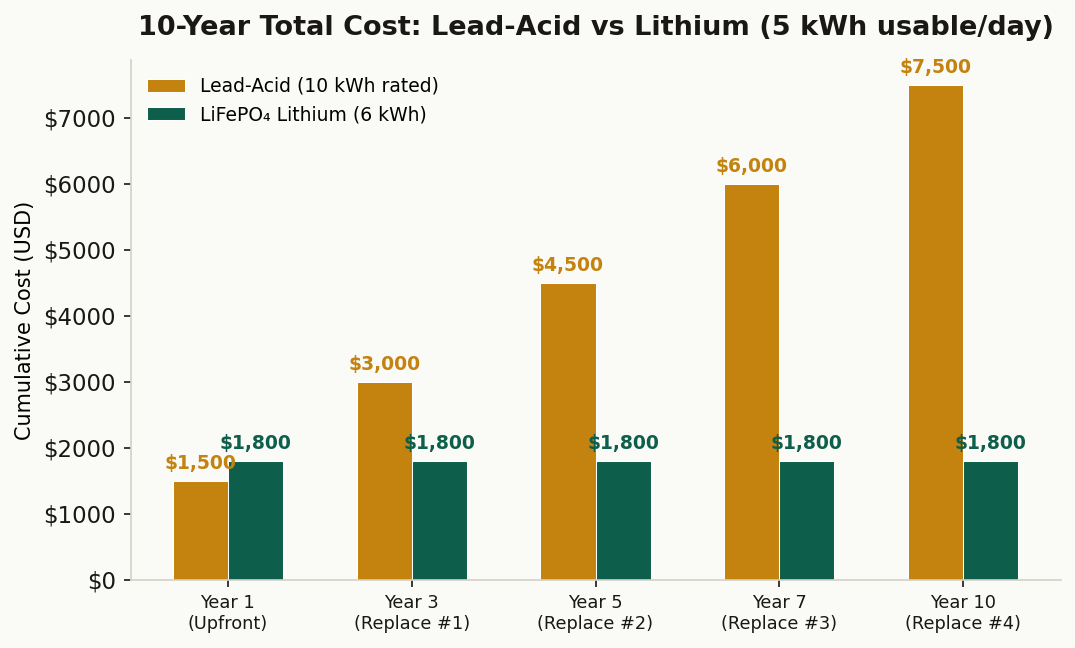
This is the calculation we walk customers through when they're debating whether to save money upfront. Let's use a real example: a home that needs 5 kWh of usable storage per day.
Lead-acid setup:
- To get 5 kWh usable, you need 10 kWh rated capacity (because you can only use 50%)
- Upfront cost: 10 kWh × $150/kWh = $1,500
- Replacement cycle: every 2–3 years (daily cycling at 50% DoD wears them out in ~800–1,000 cycles)
- Over 10 years: 4 battery replacements × $1,500 = $6,000 in battery costs
- Plus maintenance: monthly water top-ups, terminal cleaning, equalization charges
- Plus efficiency loss: 25% of your solar energy is wasted as heat in the battery
LiFePO4 lithium setup:
- To get 5 kWh usable, you need 5–6 kWh rated capacity (80–100% usable)
- Upfront cost: 6 kWh × $300/kWh = $1,800
- Replacement cycle: none in 10 years (3,000–6,000 cycles at 80% DoD = 10–16+ years)
- Over 10 years: $1,800 total in battery costs
- No maintenance
- 95% efficiency: almost all your solar energy comes back out
10-year total cost: Lead-acid ≈ $6,000 vs Lithium ≈ $1,800 — lithium is 70% cheaper.
And that's before you factor in the labor to replace lead-acid batteries four times, the fuel you burn running a generator while the batteries are being swapped, or the spoiled food from a fridge that lost power because your lead-acid bank degraded below usable capacity without you noticing.
The counterargument we hear most often: "But I don't have $1,800 upfront — I only have $500." That's a real constraint. But the solution isn't to buy lead-acid — it's to start with a smaller lithium system (2–3 kWh) and add more capacity later. Lithium scales; lead-acid doesn't.
Why do lead-acid batteries die so much faster?
The answer is in the chemistry — and it explains everything about why the cost comparison flips so dramatically.
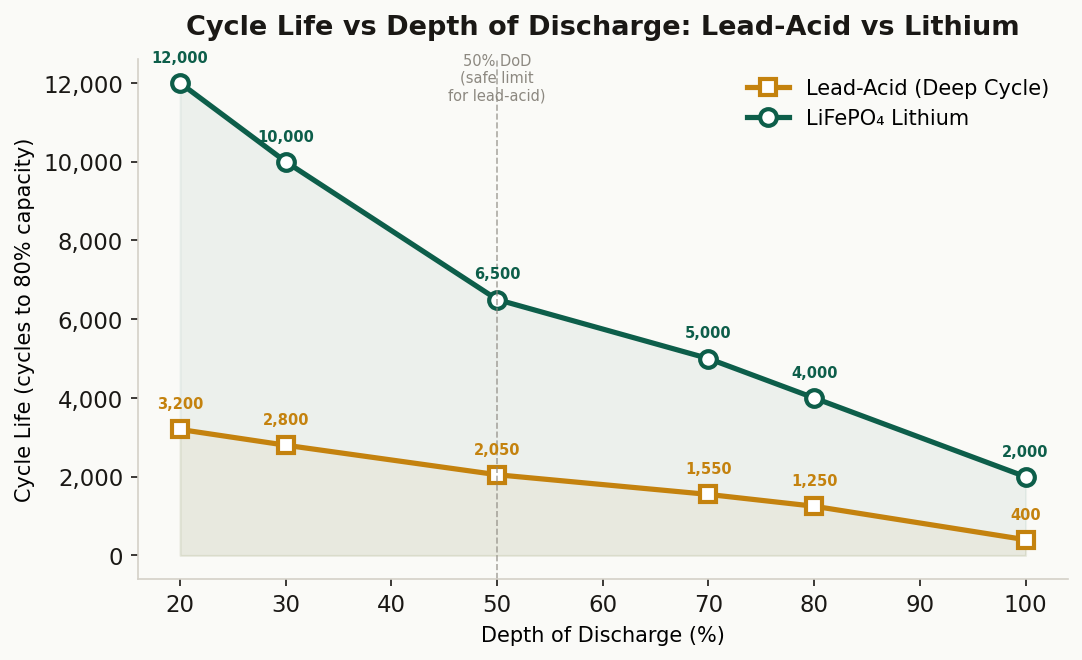
Lead-acid degradation is cumulative and irreversible. Every time you discharge a lead-acid battery, lead sulfate crystals form on the plates. If you don't recharge immediately and fully, those crystals grow larger and harder, eventually becoming permanent (sulfation). The deeper you discharge, the more sulfate forms, and the faster the battery degrades. This is why the "50% rule" exists — it's not a suggestion, it's a survival minimum. At 80% depth of discharge daily, a lead-acid battery might last 300–400 cycles (1 year). At 50%, it lasts 800–1,000 cycles (2–3 years). At 20%, it can last 3,000+ cycles — but then you need 5× the rated capacity to get the same usable energy, which destroys the upfront cost advantage.
Lithium degradation is gradual and predictable. LiFePO4 batteries lose capacity slowly and linearly — roughly 2–3% per year or 0.03% per cycle, whichever comes first. After 10 years of daily cycling, a lithium battery typically retains 70–80% of its original capacity. It doesn't fail suddenly; it just slowly stores less. And you can discharge it to 80% or even 100% every day without triggering an accelerated death spiral.
Here's the data, compiled from manufacturer spec sheets and our own customer monitoring:
| Depth of Discharge | Lead-Acid Cycles | LiFePO4 Cycles | LiFePO4 Advantage |
|---|---|---|---|
| 80% DoD | ~1,250 | 3,000–5,000 | 2.5–4× |
| 50% DoD | ~2,050 | 5,000–8,000 | 2.5–4× |
| 30% DoD | ~2,800 | 8,000–12,000 | 3–4× |
Sources: Manufacturer cycle life curves (Pylontech US5000, BYD Battery-Box, Trojan Solar SPRE); UltraLife India battery comparison; SEI Solar PV Systems textbook (Table 8-1).
At every discharge depth, lithium lasts multiple times longer. But the real-world gap is even wider because lead-acid rarely achieves spec-sheet cycle life — temperature, imperfect charging, and delayed recharging all accelerate degradation beyond lab conditions.
How much heavier is lead-acid than lithium?
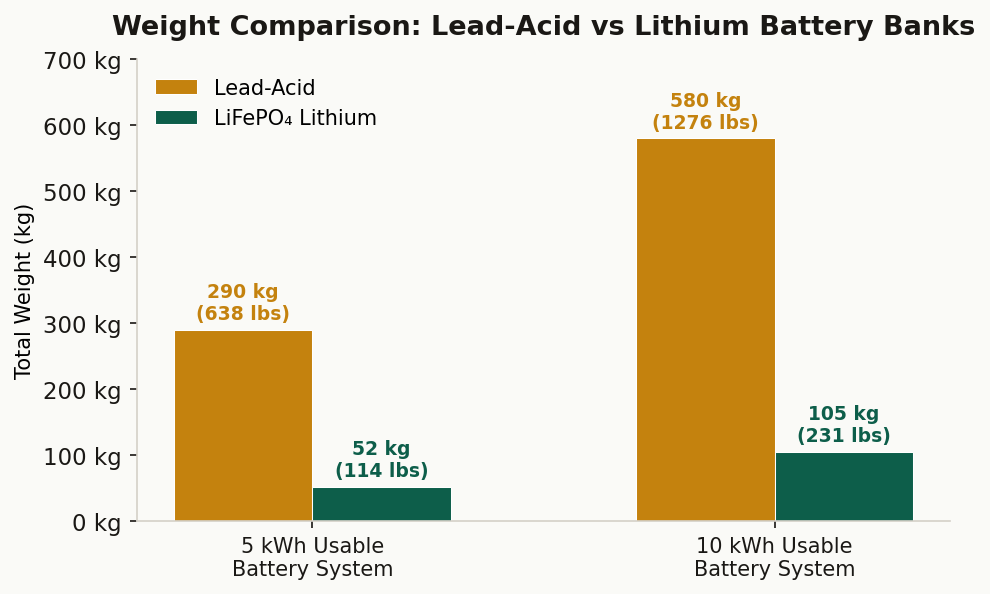
Weight matters more than most buyers realize. It affects shipping costs, installation complexity, floor loading, and what happens if you ever need to move the system.
A 5 kWh usable lead-acid bank (10 kWh rated, roughly four 200 Ah 12V batteries) weighs about 250–330 kg (550–730 lbs). A 5 kWh LiFePO4 battery weighs about 45–60 kg (100–130 lbs). That's a 5–6× weight difference.
| System (5 kWh usable) | Rated Capacity | Weight | Can one person carry? |
|---|---|---|---|
| Lead-acid (tubular) | 10 kWh | 250–330 kg | No — needs 2 people + trolley |
| LiFePO4 lithium | 5–6 kWh | 45–60 kg | Yes — wall-mountable |
In practical terms: the lithium battery can be wall-mounted in a utility room or garage. The lead-acid bank needs a dedicated floor area, a ventilated space (hydrogen off-gassing), and acid-resistant flooring. For apartments, condos, or any home without a dedicated battery room, lithium is often the only practical option.
Do lithium batteries work in hot climates?
This is the most common concern we hear from customers in Africa, South Asia, and the Middle East, and it's a fair one: lithium-ion batteries have a reputation for thermal sensitivity. But that reputation comes from NMC (nickel manganese cobalt) chemistry — the kind used in phones, laptops, and some EVs. LiFePO4, the chemistry used in home solar batteries, is different.
LiFePO4 is thermally stable to 45–50°C ambient temperature. It doesn't experience thermal runaway at normal operating temperatures. In fact, LiFePO4 handles heat better than lead-acid: above 30°C, lead-acid degradation accelerates sharply (roughly halving its lifespan for every 8°C increase). Lithium degradation is relatively flat up to 40–45°C.
We have customers in Kano, Nigeria (40°C+ summers), in Karachi, Pakistan (38°C with 80% humidity), and in Hermosillo, Mexico (45°C peak). Their lithium batteries work fine — as long as they're installed with basic ventilation. The key rules: don't enclose the battery in a sealed metal box that traps heat, don't place it in direct sunlight, and keep it indoors or in a shaded carport rather than an outdoor shed.
Lead-acid actually suffers more in heat — the electrolyte evaporates faster, requiring more frequent water top-ups, and the corrosion rate on the positive plates accelerates. In hot climates, the lifespan gap between lithium and lead-acid widens further.
Which battery type makes sense for which situation?
After helping thousands of homeowners size their systems, here's our practical recommendation matrix:
| Your Situation | Recommendation | Why |
|---|---|---|
| Daily cycling (load shedding, self-consumption) | Lithium | Lead-acid dies in 2–3 years under daily deep cycling |
| Backup-only (few outages/year) | Lead-acid okay, but lithium still better | Infrequent use favors lead-acid economics, but lithium requires zero maintenance |
| Tight upfront budget ($500–1,000) | Small lithium (2–3 kWh), add more later | Lead-acid's "savings" are a trap — you'll spend more replacing it |
| Off-grid cabin, seasonal use | Lead-acid can work | If cycled only 50–100× per year, lead-acid lasts 5–8 years |
| Apartment/condo (limited space) | Lithium only | Lead-acid is too heavy, needs ventilation, can't be wall-mounted |
| Already have a working lead-acid bank | Run it till it dies, then switch to lithium | Don't replace working batteries — but don't buy lead-acid again |
| Rural area, no lithium distributor nearby | Lead-acid if no alternative | A battery you can buy and get serviced locally beats one you can't |
The trend is clear and irreversible: lithium is replacing lead-acid in home solar at the same pace that smartphones replaced feature phones. In 2019, roughly 50% of new off-grid solar installations in Africa used lead-acid. In 2026, that's under 20% and falling. The combination of falling lithium prices (now $105/kWh at the pack level, via BloombergNEF), longer warranties, and wider distributor networks has tipped the market.
Our calculator defaults to lithium sizing because that's what we recommend for 90%+ of homeowners. Use it to get your system size, then use the pricing from our solar battery cost guide to budget for the right lithium battery.
What about the "hybrid" approach — lithium for daily use, lead-acid as backup?
Some installers propose mixing chemistries: a lithium bank for daily cycling and a lead-acid bank for extended backup during long outages. We strongly advise against this.
The problems:
- Different charge profiles — lithium charges at 14.2–14.6V constant current / constant voltage; lead-acid needs 14.4–14.8V with an absorption phase and float at 13.5–13.8V. A single charge controller can't properly serve both without compromise.
- Different discharge curves — lithium stays flat at ~12.8V until nearly empty; lead-acid voltage sags linearly. The inverter's low-voltage cutoff can't be set optimally for both.
- Circulating currents — if the two banks are ever connected to the same DC bus (even accidentally), the higher-voltage lithium bank will discharge into the lower-voltage lead-acid bank, wasting energy and potentially damaging the lead-acid batteries.
If you need extended backup, the right solution is more lithium, not adding lead-acid. A 10–15 kWh lithium bank is simpler, safer, and cheaper over time than a 5 kWh lithium + 10 kWh lead-acid hybrid.
What are the most common mistakes people make when choosing?
Based on the support calls and emails we receive:
"I'll just buy lead-acid now and upgrade to lithium later." The inverter you buy for lead-acid may not support lithium charging profiles. When you upgrade, you might need to replace the inverter too — doubling your cost. Buy a lithium-capable inverter from the start, even if you start with lead-acid batteries.
"I bought a 'lithium' battery from a market stall / online for $200 — why doesn't it work?" Counterfeit lithium batteries are rampant in markets across Africa and South Asia. They're often repurposed laptop cells in a new case with a fake label. If the price is less than $150/kWh, it's almost certainly fake. Buy from an authorised distributor.
"I didn't know I needed to water my lead-acid batteries." Flooded lead-acid batteries need distilled water every 1–3 months. If the plates are exposed to air, they sulfate and die within weeks. This is the #1 cause of premature lead-acid failure we see.
"I sized my lead-acid bank for my needs but forgot I can only use 50%." You buy a "10 kWh" lead-acid bank thinking you'll get 10 kWh of backup. You get 5 kWh. When the outage lasts longer than expected, you discharge deeper, and the batteries degrade faster. This spiral is how most lead-acid banks die within 18 months.
Our calculator automatically accounts for usable capacity and depth of discharge — it sizes the battery for what you'll actually get, not the sticker number.
Data sources:
- BloombergNEF — Lithium-Ion Battery Price Survey 2025 — battery cell and pack pricing
- UltraLife India — Battery Comparison Sheet — cycle life and DoD comparison data
- SEI Solar PV Systems Textbook — Table 8-1: Lead-Acid Cycle Life vs DoD — authoritative cycle life curves for deep-cycle lead-acid
- Pylontech US5000 Datasheet — LiFePO4 cycle life specifications
- SolBatteryCalc calculator — system sizing and savings estimates
- GlobalPetrolPrices.com — residential electricity tariffs by country
Pricing disclaimer: Battery prices referenced are EXW (ex-works) or typical installed estimates as of Q2 2026. Actual prices vary by region, distributor, and exchange rate. Installation costs typically add 15–40% to equipment cost. Lead-acid prices are for deep-cycle tubular models; automotive starter batteries are not suitable for solar use.
Last updated: June 9, 2026
About this guide: Written by the SolBatteryCalc team based on aggregated customer data from our installer network across 22 countries, manufacturer specification sheets, and direct customer feedback. We've helped thousands of homeowners choose the right battery chemistry for their specific situation — these recommendations reflect what actually works in the field, not just what looks good on a spec sheet.
Related guides: